Choosing Roofing Materials for Tornado Alley Homes
Tornado Alley punishes roofs. Hail, straight-line wind, occasional tornado spin-up — over a 20-year stretch, most Oklahoma roofs see all three. Here's what holds up.

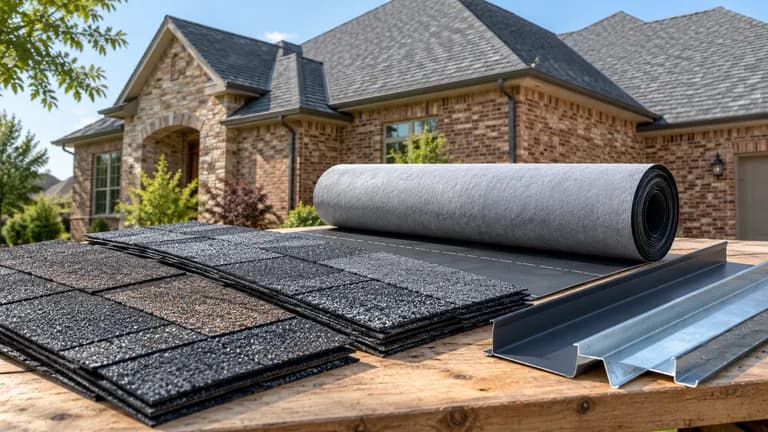
Tornado Alley punishes roofs. Hail in spring, sustained sun and heat in summer, 60–80+ mph straight-line winds during severe storms, occasional ice in winter, the rare tornado spin-up event. Over a 20-year stretch, most Oklahoma roofs see all of it. Material choice in this environment matters more than in milder climates. This guide ranks the practical options by how they actually perform in Tulsa-metro reality.
The five material categories ranked for Tornado Alley
From most to least suited for Tulsa-metro weather, by overall performance:
- Standing-seam metal
- Class 4 impact-resistant architectural asphalt
- Synthetic slate or shake
- Standard architectural asphalt
- 3-tab asphalt
Detail on each:
1. Standing-seam metal
Strongest overall performer for Tornado Alley.Metal roofs withstand hail through physics — the steel or aluminum panels resist impact in ways asphalt can't match. Wind ratings on properly installed standing-seam typically exceed 140 mph (compared to 110–130 mph for architectural asphalt). Lifespan runs 40–50 years.
Downsides:Several times the outlay of architectural asphalt on a typical Tulsa-metro home. Aesthetic isn't suited to every home (works well on contemporary designs, less appropriate for traditional craftsman or Tudor styles). Hail can produce visible cosmetic denting even when a metal roof is functionally undamaged — worth knowing if appearance matters to you.
Suited for: Long-term owners (15+ year horizon), modern or contemporary architectural styles, homeowners who prioritize hail/wind protection over upfront cost.
2. Class 4 impact-resistant architectural asphalt
Strongest value-for-money performer for Tornado Alley. Engineered to withstand 2-inch steel ball impact from 20 feet (the UL 2218 Class 4 standard) — comfortably exceeding most hail Tulsa sees. Wind ratings 110–130 mph. Lifespan 25–30 years.
Downsides: A step up from standard architectural. Aesthetic identical to standard asphalt — the protective value is invisible.
Suited for: Most Tulsa-metro homes. The cost/benefit math typically pencils out within 5–10 years once you factor in the replacements it helps you avoid in the hail belt. See our deeper analysis in Tulsa hail history and Class 4 shingles.
3. Synthetic slate or shake
Aesthetic premium option with reasonable performance.Engineered polymer or composite materials designed to mimic natural slate or wood shake. Impact resistance varies by line — some achieve Class 4 ratings, some don't. Wind ratings 110–150 mph for premium lines. Lifespan 30–50 years.
Downsides: The top of the material range for a typical Tulsa-metro home. Specialized installer requirements. Higher labour input. Some lines underperform under sustained UV and Tulsa summer heat.
Suited for: High-end homes where aesthetic matters, particularly historic Midtown homes (Maple Ridge, Cherry Street) where natural slate originals were once the standard.
4. Standard architectural asphalt
The default for most Tulsa replacements. Two-piece dimensional shingles rated by their manufacturers for 25–50 years. Wind ratings 110–130 mph for most lines. Lifespan 20–25 years in Tulsa-metro conditions (shorter than manufacturer rating due to hail and UV exposure).
Downsides: Standard impact resistance — typically Class 3 or lower. Susceptible to hail damage on impacts above 1.25-inch diameter. Most Tulsa hail damage we treat is on standard architectural roofs.
Suited for:Budget-driven replacements, shorter-horizon ownership (5–10 years), projects where the Class 4 upgrade isn't feasible for the budget.
5. 3-tab asphalt
The budget option, with the weakest performance. Single-piece shingles rated for 15–25 years. Wind ratings typically 60 mph. Lifespan 15–20 years in Tulsa-metro conditions.
Downsides: Below modern building code expectations for wind performance. High failure rate under Oklahoma weather. Lower aesthetic value (visible joints and patterns). Higher long-term cost due to shorter replacement cycle.
Suited for:Truly budget-constrained projects, rental properties where minimum compliance is the goal, properties with very short ownership horizons. We don't recommend 3-tab for owner-occupied Tulsa homes.
Wind ratings explained
Manufacturer wind ratings (110, 130, 140 mph) describe lab performance of new, properly installed shingles. Real-world performance varies based on:
- Shingle age (older = brittle = lower real-world wind tolerance)
- Sealant strip integrity (broken sealant = drastically reduced wind resistance)
- Nail pattern compliance (4 nails vs. 6 nails, hand-nailed vs. gun-nailed)
- Underlayment quality
- Geographic exposure (wind-exposed slope vs. sheltered slope)
Tulsa-metro real-world wind tolerance is typically 70–80% of the rated number. A 130-mph-rated shingle will reliably handle 90–105 mph in actual conditions; below that, individual installs may vary.
Class 4 ratings explained
UL 2218 impact resistance ratings:
- Class 1: 1.25-inch steel ball from 12 feet
- Class 2: 1.5-inch from 15 feet
- Class 3: 1.75-inch from 17 feet
- Class 4: 2-inch from 20 feet
For Tulsa hail, Class 4 covers the typical hail size range (1.5–2 inch diameter). Larger hail (the May 2013 grapefruit-sized stones) exceeds Class 4 testing, but Class 4 still significantly outperforms standard architectural in those events.
Material lifespan in Tulsa conditions
Real-world Tulsa lifespan (the meaningful number vs. manufacturer-rated lifespan):
- 3-tab asphalt: 15–18 years
- Standard architectural asphalt: 20–25 years
- Class 4 architectural asphalt: 25–28 years
- Synthetic slate or shake: 30–45 years
- Standing-seam metal: 40–50 years
The hail-impact factor is what shortens asphalt lifespan in Tulsa specifically. A standard architectural roof that would last 30 years in milder markets often hits replacement window in 20–22 in Tulsa.
Service life over a long ownership horizon
For a 30-year ownership horizon on a typical Tulsa home, the material choice is really a question of how many replacement cycles you sit through:
- 3-tab asphalt: roughly 17 years in this climate — you will replace it twice
- Standard architectural: roughly 22 years — one replacement, probably two
- Class 4 architectural: roughly 26 years — usually one replacement
- Synthetic slate: 40 years or more — none, on that horizon
- Standing-seam metal: 45 years or more — none, on that horizon
Class 4 architectural is the sweet spot for most Tulsa homeowners once you weigh the disruption of repeat tear-offs against the step up in material. Metal becomes compelling on horizons beyond 30 years; synthetic slate remains an aesthetic choice rather than a service-life-optimised one.
If you're planning a replacement, the right material depends on your home, your ownership horizon, and your budget. Call us for a no-obligation consultation — we'll walk through the options honestly and recommend based on your specific situation.